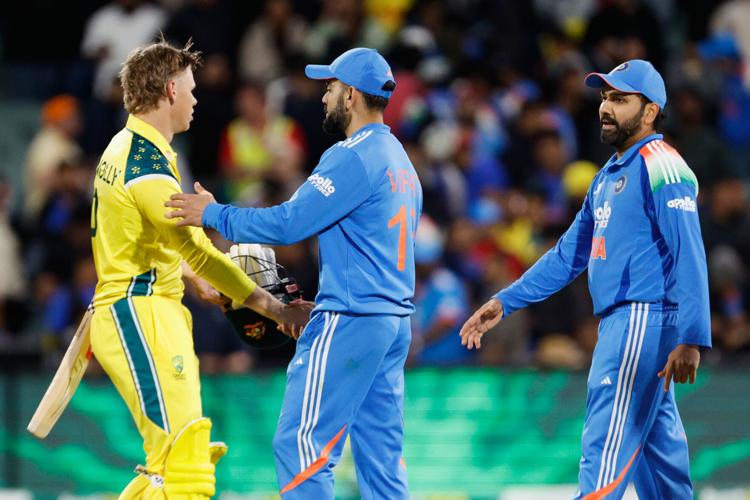
On 23 October 2025, at the Adelaide Oval, Australia sealed the three-match ODI series against India by clinching the second game with a dramatic two-wicket victory.
The Setting & Build-up
Australia, buoyed by a win in the first ODI, entered the match with momentum and home-advantage. India, on the other hand, were looking to bounce back and level the series. The toss went Australia’s way, and they chose to field first — betting on restricting India and then going after the target under lights.
India’s Innings – A Solid Platform, But Just Short
India batted first and compiled a competitive total of 264 for 9 in 50 overs.
Key contributions included:
- Rohit Sharma with a patient 73 off 97 balls, helping India steady after early hiccups.
- Shreyas Iyer chipped in with 61 off 77, putting together a useful partnership with Rohit.
- Axar Patel’s 44 off 41 added impetus in the middle overs.
However, India’s innings also had warning signs:
- Early collapse: Skipper Shubman Gill fell for just 9 and Virat Kohli was back in the pavilion for a duck — another rare failure.
- After the strong partnership, India lost momentum, with the lower order unable to add enough acceleration.
- The bowling attack that followed had to defend a good but not great total on Australian wickets.
Australia’s Chase – Composure and Craftiness Under Pressure
Chasing 265, Australia’s innings had its moments of suspense but ultimately showed grit. They reached 265 for 8 in 46.2 overs, winning by two wickets with 22 balls to spare.
Stand-out performances:
- Matthew Short scored 74 off 78, a career-best in ODIs, anchoring the chase.
- Cooper Connolly remained unbeaten on 61 off 53, seeing Australia home in the pressure-moments.
- On the bowling front for Australia: Adam Zampa returned from paternity leave to take 4 for 60, wreaking havoc in India’s middle-order.
- Also notable: Xavier Bartlett picked up 3 for 39, giving Australia a strong support in the bowling department.
Despite India’s efforts to raise the tension in the final overs, the Australians were calm. Their finishing touched other levels when it mattered.
Turning Points & Key Moments
- Australia’s decision to bowl first paid off: they capitalised on early swing and bounce to keep India from posting a massive total.
- The partnership between Rohit & Iyer allowed India to get back on track after the early losses. But India’s inability to accelerate in the final 10–15 overs cost them.
- Zampa and Bartlett’s bowling spells turned the tide: India’s middle-order never got fully settled.
- In the chase: When Australia were around 132-4, the Short-Connolly stand steadied things. From there, the Australians took control.
- Fielding lapses by India in pressure moments allowed Australia’s batters to stay alive.
- India’s bowlers picked some wickets in the late overs (Arshdeep Singh got 2, Washington Sundar 2) but it was too little, too late.
What This Means
- Australia now lead the series 2-0 with one match remaining, essentially wrapping up the contest.
- For India, while the total of 264 was competitive, it simply wasn’t enough against a home side that hunted smartly. India’s deficiency lay in converting good starts into a bigger total and then expecting its bowlers to defend it under pressure.
- Australia’s depth showed: youngsters like Connolly stepping up, and senior campaigners delivering when it mattered.
- India’s batting looked promising with the middle order contributing—but the failure of top order (Gill, Kohli) and a lack of acceleration hurt them. Also, the bowling unit lacked that extra bite needed in the death overs.
Looking Ahead – What India Must Do
- Work on death bowling: In an era where 270 + is often needed in Australia, India must tighten up death-overs (last 10).
- Top-order consistency: Kohli and Gill must find form; Rohit’s knock was encouraging but others must join in.
- Fielding standards: Under pressure, lapses cost runs and momentum.
- Building on innings: If 264 is to be defended or to set up a more dominant position, India needs 290–300 in these conditions.
- Flexibility in squad: Consider spinning wrist options (e.g., Kuldeep Yadav) to challenge Australia’s middle order outdoors.
Final Thoughts
What a contest! The second ODI delivered in tension, quality, and drama. India showed glimpses of what they can do: a solid partnership, good contributions from the middle order. But Australia out-executed them when it mattered: with both bat and ball. The home side’s young stars grabbed the spotlight, and the series is now firmly in their grip.
For Indian fans, the good news is there were positive signs. For Australia, the win underlines why they remain one of the top sides in the world. As we move to the third match, India will look to save some pride, while Australia will aim for the series clean sweep.
Recent India vs Australia 2nd ODI news
About the Author